
What does Hausgeld cover? A guide for apartment owners in Germany
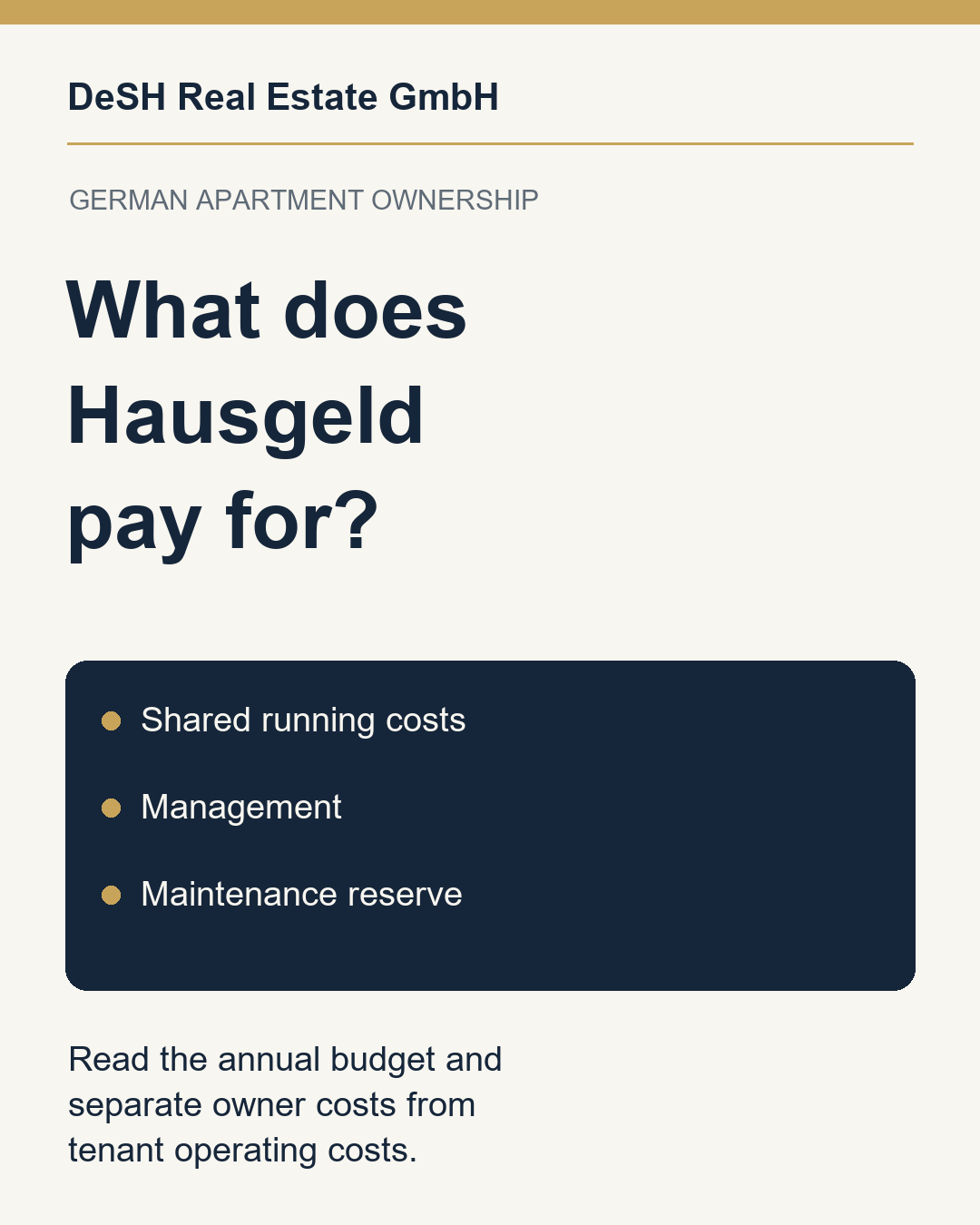
Hausgeld covers shared costs, management and reserves. The full amount is not automatically recoverable from a tenant.
Updated 28 October 2026. This is an updated English companion to an earlier DeSH article. The figures and allocation for a particular apartment depend on its own association documents and accounts.
What is Hausgeld?
If you own an apartment in a German condominium, you normally pay advances to the community of apartment owners (Wohnungseigentümergemeinschaft, WEG). These payments, commonly called Hausgeld, help fund shared building expenses, administration and the maintenance reserve. The owner remains responsible to the community whether the apartment is occupied, rented out or vacant.
What does the monthly amount cover?
The annual budget (Wirtschaftsplan) estimates income and expenses and forms the basis for the advances approved by the owners. Typical items include water and other shared operating costs, building insurance, management fees, maintenance and contributions to the reserve (Erhaltungsrücklage). The actual breakdown varies by building. The annual statement (Jahresabrechnung) then compares the budget with actual income and expenses; the owners decide on any additional payment or adjustment to the advances.
Can a landlord pass the full Hausgeld to a tenant?
No. A rental agreement may provide for the tenant to bear eligible recurring operating costs (Betriebskosten), such as certain water, cleaning, garden, lighting, insurance or caretaker costs. The permitted items and their allocation must be checked in the rental agreement and the applicable rules. Management costs and maintenance or repair costs are excluded from operating costs under the Operating Costs Ordinance, section 1(2). Contributions to a maintenance reserve are likewise an owner's expense, not simply a tenant's service charge. The distinction matters because the Hausgeld statement and the tenant's operating-cost statement are different documents.
How is each owner's share determined?
The statutory starting point is the co-ownership share (Miteigentumsanteil), but owners can adopt a different allocation for individual costs or categories of costs. Do not assume every line is divided equally or purely by apartment size. Read the declaration of division, relevant resolutions, annual budget and recent statements for the particular property. Buildings with lifts or extensive shared facilities may have higher running and maintenance costs, but a quoted Hausgeld amount alone does not show which costs an owner can recover from a tenant.
Before buying: Ask for the current Wirtschaftsplan, recent Jahresabrechnungen, the reserve balance and relevant owners' resolutions. Compare the owner's non-recoverable costs separately from any expected rent. This article explains general terms and is not an assessment of a particular purchase or rental agreement.
Official sources: WEG section 16 (allocation) · WEG section 28 (budget and annual statement) · BGB section 556 (tenant operating costs) · Operating Costs Ordinance.